
What Jane Austen Ate and Charles Dickens Knew. From Fox Hunting to Whist-the Facts of Daily Life in 19-Century England - Daniel Pool
- Dodał: administrator
- Data: 10:06 21-11-2018
- Kategoria: Historia
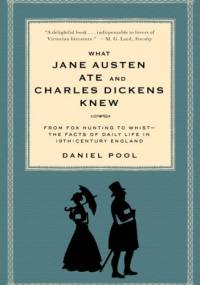
For every frustrated reader of the great nineteenth-century English novels of Austen, Trollope, Dickens, or the Brontës who has ever wondered whether a duke outranked an earl, when to yell "Tally Ho!" at a fox hunt, or how one landed in "debtor's prison," here is a "delightful reader's companion that lights up the literary dark" (The New York Times). This fascinating, lively guide clarifies the sometimes bizarre maze of rules, regulations, and customs that governed everyday life in Victorian England. Author Daniel Pool provides countless intriguing details (did you know that the "plums" in Christmas plum pudding were actually raisins?) on the Church of England, sex, Parliament, dinner parties, country house visiting, and a host of other aspects of nineteenth-century English life -- both "upstairs" and "downstairs." An illuminating glossary gives at a glance the meaning and significance of terms ranging from "ague" to "wainscoting," the specifics of the currency system, and a lively host of other details and curiosities of the day. źródło opisu: www.catalog.simonandschuster.com źródło okładki: www.catalog.simonandschuster.com
| data wydania | 21 kwietnia 1994 | ||
| kategoria | historia | ||
| liczba stron | 416 | ||
| język | angielski | ||
| słowa kluczowe | Jane Austen, Charles Dickens, Anglia, XIX wiek, historia Anglii | ||
| ISBN | 9780671882365 |
Rejestracja jest za darmo i jest bardzo szybka! Kliknij tutaj aby założyć konto. Trwa to tylko 15 sekund!.
Podobne wpisy do What Jane Austen Ate and Charles Dickens Knew. From Fox Hunting to Whist-the Facts of Daily Life in 19-Century England - Daniel Pool
The Importance of Being Earnest - Oscar Wilde
Oscar Wilde's brilliant play makes fun of the English upper classes with light-hearted satire and dazzling humour. It is 1890's England and two young gentlemen are being somewhat limited with the truth. To inject some excitement into their lives, Mr...

The Last Man - Mary Shelley
Mary Shelley wrote The Last Man eight years after Frankenstein, on returning to England from Italy after her husband Percy's death. It is the twenty-first century, and England is a republic governed by a ruling elite, one of whom, Adrian, Earl of Win...
The Time of Terror - Paul Bryers
1793: The French have killed their king and are about to embark on the violent peroid of bloodletting known as the Terror. Brig-sloop Commander Nathan Peake is on smuggler patrol off the Sussex coast and desperate for some real action. As revolutiona...

My England Years - Robert Charlton
Sir Bobby Charlton is widely acknowledged as the greatest player ever to wear an England shirt. He won a record number of caps and scored a record number of goals. Here, in the second volume of his bestselling autobiography, Sir Bobby talks in detail...

Uncle Bernac. A Memory of the Empire - Arthur Conan Doyle
This was one of several fictional historical works that Doyle wrote during the last five years of the 19th century, as he tried to find something to replace Sherlock Holmes. First published in 1897, this murder mystery relates the story of a young Fr...
The Nigger of the Narcissus. A Tale of the Sea - Joseph Conrad
The Nigger of the Narcissus was written in 1896 and is loosely based on Conrads own experiences as a sailor; in 1884, Conrad made a voyage on the real Narcissus from Bombay to Dunkirk as a Second Mate, and some of the events described in his novella...