
Education of tomorrow. Organization of school education
- Dodał: administrator
- Data: 09:38 21-11-2018
- Kategoria: Informatyka i matematyka
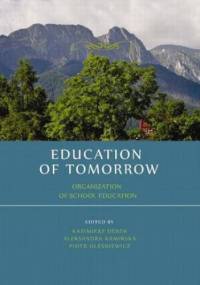
Education of tomorrow as an idea, scientific message to horizons of the desired systemic changes and of those in everyday life, it raises recognition and has hopes for implementation into the practice of the educational process, education, and care. In fact, the Education of tomorrow calls for the expectations and hopes that research, as a result of the criticism of imperfect mechanisms of reforms implementation, particularly at the turn of the twentieth and twenty-first century, will be continued and revitalized, including on the basis of the very educational research. Travestying of what years ago (1968) Cyprian Norwid wrote: Past it is today, but anything further; the future is today closer than it seems, where Time does his thing. And you, man? you should utilize it to improve education. In general, we mean the wider education including, among others, care from birth to old age, education focused on finding the hidden development potential in the richness of the directional and instrumental characteristics (values), often of innate abilities, corresponding with talent, as well as the preparation of learning related to changing social, professional and free time roles. Going back to the title of the multiauthored monograph, focused on the organization of school education, one should refer to its semantic content, since the term organization has a diversified credit. Well, according to sociologists, it is a social community of the school, but also of relationships and social bonds, according to psychologists it should be understood primarily in terms of activities aimed at improving the working conditions and efficiency, without losing sight of the employee and customer-student satisfaction. In turn, in the opinion of work pedagogists, the learning process, taking different forms geared towards a system of selection and management of people and work tools and of infrastructure, must be emphasized. In the Education of tomorrow, the specific roles established and implemented, though often hidden, are played by the teacher as a person. There is a need to clearly emphasize the term role playing, because too often is also used in relation to the school in terms of metaphor. Discussion on the idealization or criticism of metaphorical relating to roles of the teacher is important and meaningful, because in education practice, seldom do teachers have innovative and creative attitudes. This is because as French sociologist Alain Touraine convinces: the result of this process (aimed at the end of the society) is to receive content and meaning of the institutions of modern society, organized in nation-states. Even if there are political parties, trade unions, public institutions, they play less and less of a role in making sense of human life and the coordination of individuals and groups. They become simply points providing services to the public, more often, on a commercial basis. The population in the face of so changing institutions is transformed into consumer, individualization progresses. Issues concerning the end of the society were also undertaken by Polish sociologist Mirosława Marody, paying attention to: 1) the economic success of the business unit and the State; 2) competitive resistance from the other values to build a world around a religious, ethnic, national community; 3) combining the opportunity to live in harmony with each other, on the basis of social life with autonomy and freedom of the individual. Jan Sowa also writes about the disease of capitalism and crisis of liberal democracy. This philosopher and sociologist exposes things that, as postulated models, generally do not lead to good results, e.g.: 1) pseudoliberalism involving modernization of the cargo cult, as the ability to copy infrastructural solutions of more developed countries; 2) neosarmatian conservatism looking for source of Polish force in the restoration projects of cultural and political codes of the Polish-Lithuanian Commonwealth; 3) return to the idea of a new society as a social democratic state and society associated with the Solidarity movement, which broke out in 1980. Referring to the scientific paradigms about the crisis of capitalism, in the neo-liberal version and of initiated process leading to the end of the individualization of society and the individual as such, the matter of Education of tomorrow and the organization of school education, within the next decade will appear to be rather negative. It is true that from the point of view of metaphorical and deterministic chaos theory, the initial factors identified and causative elements list are both extensive, but the unknown is probably even bigger, as is the need for discussions and initiatives in the form of practical measures. On the other hand, leaning over general and subject-specific didactics, also integrated in forms of assistance to a child with disabilities and their family, one should recognize the cognitive-ideological declarations and the real facts, including ones relating to the area of childcare (up to 3 years), preschool and school children as well as youth, pedagogization of parents, as well as clericalization of public life in schools. All this must arouse concern, therefore, in the final part of this collective monograph we find an important dialogue on education and a description of the educational situ\ation in Sweden, where the principle of egalitarian democracy somehow complements the context of reflection on Education of Tomorrow and the organization of school education as such. Readers are encouraged for a deeper reflection on the multifaceted threads contained in the unique articles, as well as the Chinese proverb which says that it is easier to build a school as an institution, than to have good teachers and to continue to improve it. Kazimierz Wenta (Wstęp) źródło opisu: Helion źródło okładki: Helion
| kategoria | informatyka i matematyka | ||
| język | polski | ||
| data wydania | 7 czerwca 2016 | ||
| ISBN | 9788364788277 |
Rejestracja jest za darmo i jest bardzo szybka! Kliknij tutaj aby założyć konto. Trwa to tylko 15 sekund!.
Podobne wpisy do Education of tomorrow. Organization of school education

The Supervillain and Me - Danielle Banas
In Abby Hamilton’s world, superheroes do more than just stop crime and save cats stuck in trees—they also drink milk straight from the carton and hog the television remote. Abby’s older brother moonlights as the famous Red Comet, but without powers o...

Kiss At Your Own Risk - Stephanie Rowe
He needed a killer woman... Blaine Underhill is one lucky man after having recently escaped a century and a half of imprisonment at the hands of an evil witch. Now he’s determined to save his still-enslaved friend, but in order to do so, he’ll need t...

Making Handmade Books - Alisa Golden
In the digital world, books may seem like an endangered species, but bookmaking is more popular than ever. Thanks to the 100 ideas here, beginners will be on their way to folding, gluing, and sewing books in a variety of styles, from rolled scrolls t...

Oculoplastic Surgery with DVD - J. Long
Whether you re in training or an established practitioner, Oculoplastic Surgery, a brand-new title in the Surgical Techniques in Ophthalmology Series, is your go-to manual for expert guidance on how to master new procedures, improve outcomes, and lea...

Medical Therapy of Breast Cancer - Z. Rayter
There have been very significant advances across many areas of the study, investigation and treatment of breast cancer. This new publication brings these developments fully up to date and surveys how scientific advances have influenced, improved and...

Blane - Angela Cameron
In the third book of Angela Cameron's steamy trilogy about a vampire mafia, we discover Blane's hidden passions and struggle to succeed within the vampiro hierarchy. We get glimpses into Michael and Tori's established relationship, and learn more abo...